
IGA Capital Macro Update
Global financial markets are navigating a profound thematic shift characterized by an aggressive rotation out of mega-cap technology, an unwinding of front-month energy premiums, and a sharp escalation in Middle East kinetic exchanges. While a global semiconductor selloff triggered a correction in cap-weighted indices, the broader market experienced a healthy diversification, pushing the equal-weighted S&P 500 to historic highs. In fixed income, safe-haven flows and cooling month-on-month inflation data fueled a powerful Treasury rally. Concurrently, the Federal Reserve under Chair Kevin Warsh is hardening its hawkish posture, reinforcing the "higher-for-longer" or potential tightening regime as structural pipeline costs remain elevated.
June 29, 2026
Dubai, UAE

Macro & Equities
The undisputed dominant trend of the past week was "the great decoupling"—a stark operational divide where mega-cap technology corrected sharply while cyclicals and economically sensitive sectors marched upward.
Tech Sector Correction: The AI trade that consistently driven markets for the better part of two years cracked. A global semiconductor rout originating in Asia pushed the SOX Index down nearly 7% in its worst single session since April 2025. Amplified by institutional reports that OpenAI may postpone its IPO pipeline, the Mag7 ETF slid 6% on the week, dragging the tech-heavy Nasdaq 100 down nearly 5%.
The Rotational Expansion: Unlike prior corrections, the broader market refused to follow tech downward. The Dow Jones Industrial Average and the Russell 2000 both closed in positive territory as capital rotated aggressively into cyclical value. Supported by falling oil prices, the equal-weighted S&P 500 hit record highs, outperforming its cap-weighted counterpart by the widest margin in over six years and signaling a healthier, broader bull market.
Economic Indicators: May PCE data provided a modest reprieve, with month-on-month headline inflation crossing 0.1% cooler than consensus estimates. However, with headline PCE stubbornly tracking at 4.1% YoY, the macro reality remains far from the Fed’s 2% target.
Geopolitical Escalation
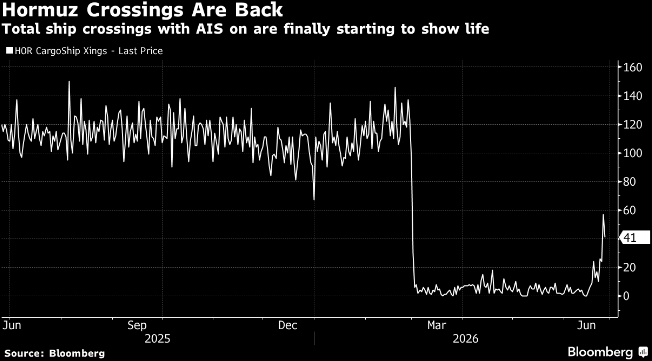
A sequence of severe ceasefire violations over the weekend has put the 60-day negotiating window under the Versailles MOU on life support. Following an Iranian drone strike on a commercial cargo ship in the Strait of Hormuz, a full-blown tit-for-tat military exchange unfolded:
US Central Command executed retaliatory airstrikes on Iranian missile storage arrays and coastal radar installations.
Iran targeted a Qatari oil tanker, triggering a second wave of US strikes hitting 10 unique strategic assets, including surveillance, air defense, and minelaying systems.
The IRGC retaliated with missile and drone strikes against eight US regional military facilities, including high-security logistics bases in Kuwait and Bahrain.
The Joint Maritime Information Center has elevated the Hormuz threat level to "substantial." While Washington is forcefully expanding transit routes near Oman to preserve seafaring commerce, international insurance premiums and maritime logistics are bracing for prolonged disruption.
Impact on the UAE Economy
For the UAE and the broader GCC economic framework, this kinetic escalation presents a dual-track landscape. The expansion of secure southern maritime routes directly leverages the UAE's sophisticated multi-port logistics networks outside the immediate conflict chokepoints. Furthermore, the persistent military friction continues to anchor regional defense allocations and institutional safe-haven capital inflows into Dubai's real estate and sovereign wealth ecosystems. However, the threat to local maritime stability demands heightened corporate risk mitigation, balancing booming domestic corporate credit demand against shifting logistical overhead.
Commodities, Energy & Metals
Extreme geopolitical volatility and global equity reallocation triggered sharp pricing movements across the real asset landscape.
Energy Prices
Crude Oil (WTI & Brent): Despite intense military exchanges over the weekend, front-month crude futures aggressively surrendered their remaining short-term geopolitical risk premium. Prompted by equity liquidations and shifting macroeconomic demand models, WTI crude dropped below $70/bbl, settling near $69.45/bbl. Brent crude experienced matching downward pressure, as the broader market prices in an aggressive US military resolve to keep maritime energy corridors open by force.
Precious Metals
Gold: Spot gold captured active flight-to-safety flows as global tech equities unwound, trading firmly at $4,168.20/oz. Bullion continues to serve as an indispensable structural hedge for global asset managers navigating the deterioration of the Versailles MOU and structural fiat currency inflation.
Silver: Spot silver remained securely bid alongside gold, reflecting robust underlying monetary premium and industrial positioning amid the broader macro sector rotation.
Industrial Metals
LME Copper: Base metals are holding a highly constructive baseline, with London Metal Exchange (LME) Copper hovering near $13,530.50 per ton. The metal is well-supported by multi-layered structural mine deficits and highly depleted scrap channels, even as near-term industrial consumption factors adjust to tightening central bank policy paths.
Fixed Income & Treasury Yields
Treasuries caught an exceptionally strong bid, driven by a perfect convergence of flight-to-safety flows out of global tech indices and the sharp correction in raw energy input costs.
Yield Adjustments: The policy-sensitive 2-year yield tumbled 15 basis points to 4.08%, almost entirely erasing the hawkish run-up that followed the mid-June Fed meeting. The benchmark 10-year US Treasury yield dropped 14 basis points to close at 4.37%, while the 5-year yield emerged as a focal point for the disinflation trade, falling to 4.12%.
Supply & Technical Outlook: The Treasury curve enters the new quarter with a clean technical runway, as the next coupon auction slate (3s, 10s, and 30s) is entirely clear until July 7–9. Near-term focus centers on the July 2 Nonfarm Payrolls report. Following May's blockbuster 172k print, a subsequent hot jobs report risks reigniting violent short-end repricing, while Morgan Stanley warns of heightened systemic volatility given the Fed’s shift toward minimal forward guidance.

Federal Reserve & Monetary Policy
The policy path debate has hardened significantly, with CME FedWatch futures now pricing a 77% probability of at least one 25bp rate hike by year-end.
Internal Policy Friction: The FOMC’s internal tolerance for inflation patience is narrowing. Minneapolis Fed President Kashkari explicitly confirmed he has adjusted his dot-plot baseline from one cut to one hike, emphasizing that core inflation remains too high even when removing volatile energy inputs. Chicago Fed President Goolsbee echoed this hawkish stance, noting that aggregate inflation metrics continue to move in the wrong direction.
The Warsh Restructuring: Chair Kevin Warsh is aggressively executing a fundamental rewiring of the central bank. Invoking Alan Greenspan as a structural model, Warsh is deliberately concentrating authority within the Chair’s executive office, minimizing public forward guidance, and establishing five elite task forces to overhaul communications, the balance sheet, data sourcing, and inflation frameworks. Notably, the Atlanta Fed's presidential search has stalled, effectively granting Chair Warsh direct leverage over a critical 2027 FOMC voting seat.

FOMC Meeting – Implied Fed Funds Rate
Implied Overnight Rate: 3.628%
July 29, 2026 (Upcoming Meeting): 3.703%
December 9, 2026 (Year-End Last Meeting): 3.943%
June 9, 2027 (Mid-Year Meeting): 3.958%
Economic Calendar
Date | Indicator / Event | Market Significance |
Monday, 6/29 | No material data releases | Quarter-end institutional rebalancing flows dominate. |
Tuesday, 6/30 | US Consumer Confidence; JOLTS Job Openings | Assessment of corporate labor demand and consumer resilience. |
Wednesday, 7/1 | ADP Private Payrolls; S&P Global US Manufacturing PMI; ISM Manufacturing | Initial private labor print and crucial manufacturing health indicators; Chair Warsh speaks at ECB Symposium. |
Thursday, 7/2 | US Nonfarm Payrolls; Unemployment Rate; Initial Jobless Claims; Durable Goods | High-Stakes Macro Event Risk. Markets close early at 2:00 PM EST. |
Friday, 7/3 | US Financial Markets Closed | Independence Day (Observed). |

If you have any questions or would like to discuss a loan request, please reach out to me using the contact information below.
Best Regards,
Joshua Hawley

+971 50 764 0788


Comments